
When the Stuff Feels Like It's Closing In: Dealing with Overwhelm During a Major Cleanout
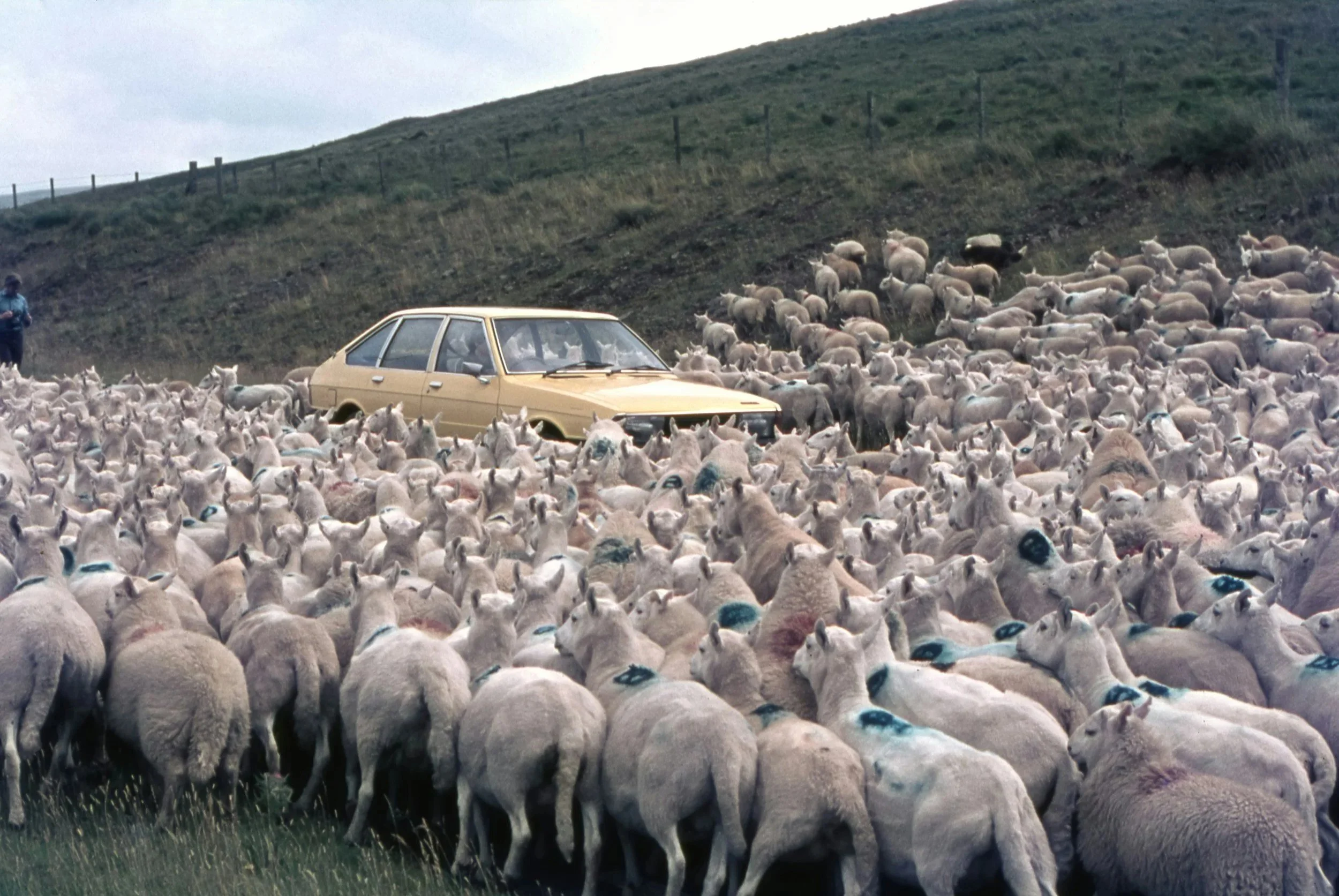
A small car in the fields surrounded by a herd of shaved sheep
Standing in front of a lot of stuff
That tight, buzzing feeling when you open the door to the spare bedroom, or the garage, or the storage unit, and you see it all. Boxes stacked on boxes. Furniture wedged into corners. Bags of who-knows-what piled against the walls. You came in with a plan, maybe, or at least with good intentions. But now you're just standing there, and the plan is gone, and all you can think is: I cannot do this.
You're not alone in that feeling. Not even close. Nearly every person I've spoken to who has been through a major household cleanout describes some version of this moment. The walk-in-and-freeze moment. The close-the-door-and-drive-home moment. The sit-on-the-floor-and-stare moment. It's so common it should be listed in the stages of grief, somewhere between anger and acceptance.
Why a cleanout can feel physically impossible
That feeling has a name in psychology, or at least pieces of it do. Researchers at the Institute of Living and Yale School of Medicine found that for some people, the act of discarding possessions produced unusually intense activity in the anterior cingulate cortex and insula (regions that flag what matters to us and register distress. The study, published in 2012 in Archives of General Psychiatry (https://pubmed.ncbi.nlm.nih.gov/22868937/), focused on people with hoarding disorder, but the underlying mechanism, the emotional weight of letting go, exists on a spectrum that includes all of us. You don't need a clinical diagnosis to feel paralyzed by a room full of your late mother's things. You just need to be a person with feelings and a working insula.
The three sources of cleanout overwhelm
The overwhelm usually comes from one of three places, and sometimes all three hit at once in a kind of emotional pileup. The first is sheer volume. Our brains aren't great at processing enormous, undifferentiated tasks. When you look at a house full of stuff and think "I need to deal with all of this," your brain doesn't see a sequence of manageable steps. It sees a wall. A cliff. An ocean. People often call this "task paralysis," and it's the same reason people procrastinate on big projects at work. The task feels so large that starting anywhere feels pointless, like bailing out a swimming pool with a teaspoon.
The second source is emotional attachment. Every object in that house is a potential trigger. The coffee mug your dad used every morning. The quilt your grandmother made by hand. The box of cards your kids drew in elementary school, the ones with the backwards letters and the stick-figure families. Picking up each item forces a micro-decision: keep, donate, sell, or throw away. And each of those decisions carries an emotional charge. Multiply that by hundreds or thousands of items, and you're not just sorting stuff. You're processing grief, nostalgia, guilt, and love, one object at a time. It's emotional cardio, and nobody trained for it.
The third source, and this one doesn't get enough attention, is decision fatigue. Every choice you make, no matter how small, drains a finite daily resource. A well-known study published in the Proceedings of the National Academy of Sciences (https://www.pnas.org/doi/10.1073/pnas.1018033108) showed that judges made significantly different parole decisions depending on where the case fell in their daily schedule, not because of the case details but because their capacity for careful decision-making deteriorated as the day wore on. Now imagine making hundreds of keep-or-toss decisions in a single afternoon. That study has been challenged but the broader finding, that decision quality degrades as the decisions pile up, is well supported elsewhere. By hour three, you're either keeping everything out of exhaustion or throwing everything away out of frustration, and neither feels right the next morning.
So what actually helps?
I want to be careful here, because the internet is full of tidy advice from people who have apparently never stood in a dead relative's kitchen holding a spatula and crying. "Just start with one drawer!" they chirp from their spotless minimalist apartments. Great. Helpful. Thanks.
But there are some approaches that genuinely reduce the overwhelm, and they come not from productivity gurus on Instagram but from people who do this kind of work every day: estate sale professionals, professional organizers, grief counselors, and families who have survived it and can tell you what worked.
You are not supposed to do this alone
The first thing that helps, and I mean this with my whole chest, is accepting that you don't have to do this alone. That sounds obvious, but a surprising number of people try to handle a major cleanout solo, either because they feel like it's their responsibility as the eldest child or the executor, or because they don't want to burden anyone else who's also grieving, or because they're embarrassed by the volume. Call in help. That might mean hiring a professional estate sale company that handles everything from pricing to cleanup. It might mean asking three friends to come over on a Saturday with a promise of pizza and beer and the understanding that they won't judge the state of the basement. It might mean hiring a junk removal service for the things nobody wants. The specific form of help matters less than the principle: you are not supposed to do this by yourself. Nobody is.
Start with the stuff that has no memories attached
The second thing is to give yourself permission to not start with the hard stuff. You don't have to open the memory boxes on day one. In fact, please don't. Start with the basement. Start with the garage. Start with the stuff that has no emotional charge whatsoever, the broken vacuum, the expired cans of paint, the stack of old phone books from 2004, the mystery cables that don't connect to anything manufactured this century. Getting those things out of the way creates physical space, and almost magically, mental space too. Momentum is real and psychological. Once you see one room start to clear, the next room feels slightly less impossible. Once you've filled one dumpster, the second one feels like progress, not punishment.
The three-pile method
The third approach is what I call the "three pile" method, though I'm sure someone else named it first. Every item goes into one of three categories: definitely keep, definitely go, and decide later. Notice what just happened. Earlier I said every item forces a choice between keep, donate, sell, or throw away. This collapses that. Donate, sell, and throw away are all just go — the difference between them is a logistics question, not an emotional one, and it can be answered later by you or by somebody else entirely. You've gone from a four-way judgment to a two-way one, with a place to put anything you can't answer. That "decide later" pile is crucial. It's not avoidance. It's strategic mercy. It gives you permission to not make every decision right now, on the worst possible day, when your emotional tank is empty. Put the uncertain things in boxes, label them with the date and a vague description, and come back in a week or a month when you have more emotional distance. Some people set a deadline for those boxes: if I haven't gone through this by June, everything in it gets donated. That works for some people. Others need more time. Both approaches are legitimate.
What to do about the guilt
A note about guilt, because it's the silent engine driving a lot of this overwhelm. Guilt about getting rid of things your parents valued. Guilt about not wanting things your parents wanted you to have. Guilt about the fact that you're kind of relieved the house is getting cleared out, even though the reason it's being cleared out is terrible. Guilt about feeling guilty. The guilt stacks up like the boxes, and it makes every decision heavier than it needs to be.
Here's what I want to tell you about that guilt: it's normal, and it doesn't make you a bad person. Not even a little bit. The objects are not the people. Your mother is not her china set. Your father is not his tool collection. You can love them completely and utterly and still let things go. Keeping every physical object doesn't keep them alive. It just keeps you from having a guest room.
A grief counselor I spoke with put it this way: "People think that keeping the objects keeps the person alive. But the memories live in you, not in the stuff. The stuff just takes up space in your house and your head." She went on to say that in her experience, the families who have the healthiest relationship with grief are often the ones who keep very few physical items but tell a lot of stories. The stories are what matter. The memories are what last. The ceramic frog your mom kept on the windowsill can go to Goodwill without taking a single memory with it.
Handling the logistics without drowning
There's a practical element to the overwhelm that deserves attention too, because not all of it is emotional. Some of it is just logistical confusion. Where do you even take the donations? What's the number for the junk removal company? Do you need a permit for a dumpster in the driveway? Can you put furniture on the curb for bulk trash pickup, or does your city require a special request? These are small questions individually, but when you're already emotionally depleted, each one feels like another brick on the pile. If you can delegate the research to someone else, a friend, a family member, even a virtual assistant for an afternoon, do it. You don't need to answer every logistical question yourself.
The surprises nobody warns you about
I also want to acknowledge something that almost nobody talks about publicly: the weird, disorienting experience of discovering things you didn't know about your parent or loved one. Hidden letters. An unexpected bank account. A collection you never knew existed. Sometimes these discoveries are charming, like finding a shoebox full of love letters from the 1960s. Sometimes they're complicated. A family I spoke with found thousands of dollars in cash stashed inside books throughout the house. Another found evidence of a hobby their father had never mentioned to anyone. These surprises can add an extra layer of emotional processing on top of an already overwhelming task. Give yourself room for them. They're more common than you'd think.
If you're in the thick of it right now
Reading this on your phone in the driveway because you can't bring yourself to go back inside, here's what I want you to hear. It's okay to stop for today. It's okay to close the door and come back tomorrow or next week. It's okay to hire someone to handle it so you don't have to. It's okay to keep things that matter to you and let go of things that don't, even if someone else would have kept them. There is no right way to do this. There is only your way, and your way is enough.
The overwhelm will pass. Not all at once, and not as quickly as you'd like. But it will pass. And on the other side of it is a cleared space, both physical and emotional, that you didn't think was possible when you were standing in the doorway, staring at the boxes, wondering where on earth to begin.
Contact us to set up a free walkthrough and see how we can help.